
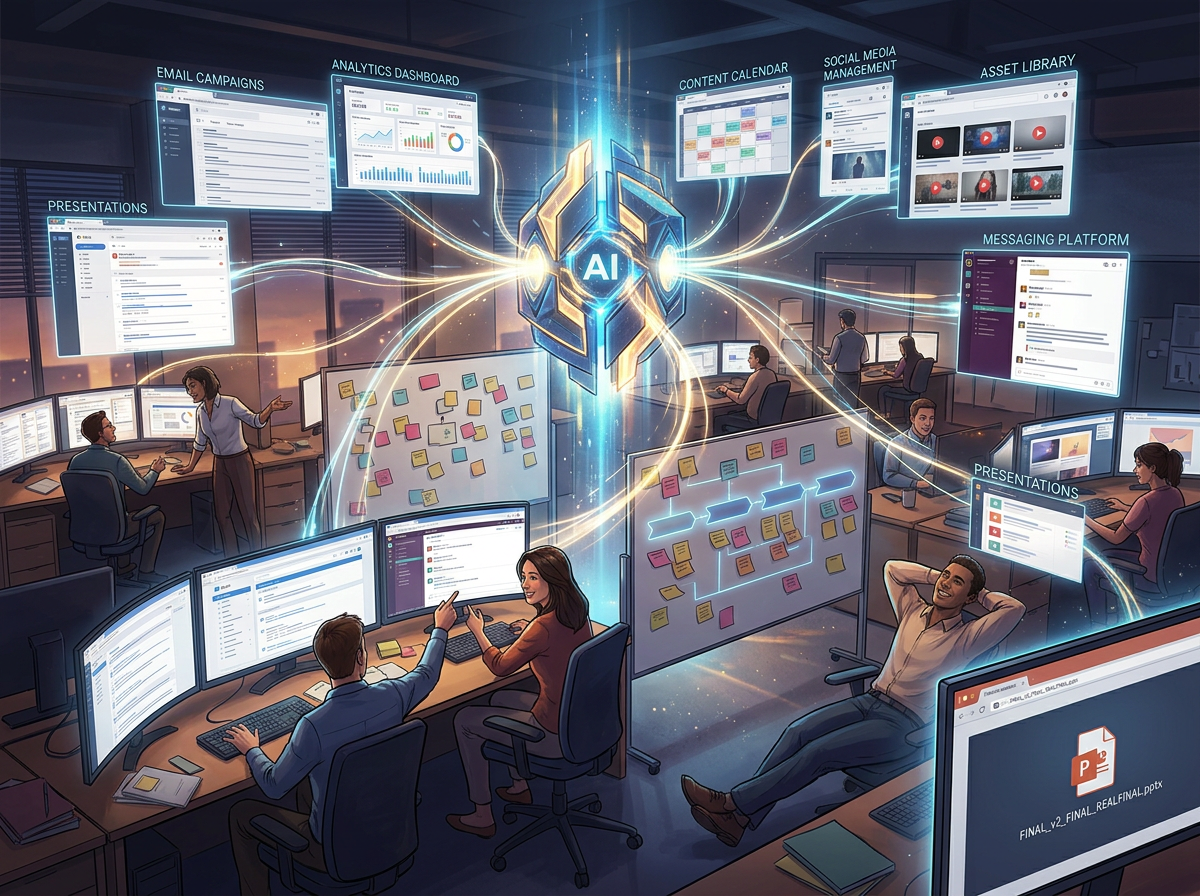
For the past two years, most marketing teams have used AI like a very fast junior copywriter who never sleeps and answers you at 2:14 a.m.
“Write this email.”
“Summarize this meeting.”
“Give me five headline options.”
“Make this sound less corporate and more human.”
“Now make it shorter.”
“Now punchier.”
“Now less punchy.”
Helpful? Absolutely. But that’s not where the industry is headed anymore.
The biggest shift happening in AI right now is not better content generation.
It’s workflow execution.
And honestly, I think a lot of organizations still haven’t realized the magnitude of that change because they’re still busy arguing about whether employees are allowed to use ChatGPT for meeting notes.
Meanwhile, the AI industry has already moved on to:
- persistent agents
- proactive workflows
- cross-platform orchestration
- system-level coordination
- AI operating across multiple tools simultaneously
At Google I/O, nearly every major announcement pointed toward the same future:
AI that doesn’t just answer questions…
…but helps coordinate and execute work.
That’s a very different world than:
“Write me a LinkedIn caption about synergy.”
The Industry Keeps Talking About Prompts. The Real Shift Is Workflows.
This is where I think the AI conversation keeps getting stuck in the shallow end of the pool.
Everybody wants:
- prompt libraries
- AI hacks
- AI shortcuts
- “10 prompts that will change your life”
- someone on LinkedIn yelling that ChatGPT replaced their entire marketing department while clearly still posting from their marketing department
But prompting alone is rapidly becoming commoditized.
The real competitive advantage is shifting toward:
- workflow design
- orchestration
- governance
- integration
- knowledge systems
- repeatable execution
In other words: the workflow matters more than the prompt.
Because AI is moving beyond isolated outputs.
It’s starting to:
- monitor
- coordinate
- summarize
- analyze
- retrieve
- recommend
- organize
- trigger actions
- connect systems together
That changes the role AI plays inside organizations entirely.
What Agentic AI Actually Means
There’s a lot of buzzword inflation happening around “agentic AI” right now.
Somewhere out there, a startup founder is describing a slightly enhanced chatbot as “an autonomous cognitive orchestration layer.”
We all need to calm down.
So let’s simplify it.
Agentic AI means AI systems that can:
- maintain context
- operate across multiple steps
- interact with systems
- complete tasks semi-autonomously
- persist across workflows
Not perfectly.
Not magically.
And definitely not without human oversight unless your goal is “surprise crisis communications event.”
But enough to fundamentally change how operational work gets done.
For marketing and communications teams, this becomes incredibly important because so much of marketing work is actually process coordination disguised as productivity.
Think about the average day inside a marketing department:
- monitoring trends
- preparing executive briefings
- organizing campaign assets
- reviewing reports
- routing approvals
- maintaining messaging consistency
- summarizing meetings
- preparing presentations
- tracking competitors
- coordinating stakeholders
- trying to remember where the FINAL_final_v2 deck actually lives
Most of this work exists across fragmented systems:
- Teams
- Slack
- Docs
- PowerPoint
- spreadsheets
- browsers
- dashboards
- CRM systems
- social platforms
- approximately 73 tabs open at all times
The next generation of AI is being designed to operate across those systems.
That’s the real shift happening right now.
The Future of Marketing Is Not More Content. It’s Faster Coordination.
This is something I think many organizations still misunderstand.
We are already drowning in content.
The internet does not currently suffer from a lack of thought leadership carousel posts.
The bottleneck inside most organizations is not:
“Can we create another blog post?”
The bottleneck is:
- alignment
- coordination
- approvals
- information retrieval
- workflow fragmentation
- inconsistent execution
- disconnected systems
- institutional knowledge loss
- Karen being the only person who knows how the reporting spreadsheet works
Agentic AI directly targets those operational problems.
That’s why companies making real progress with AI are focusing less on novelty…
and more on operational efficiency.
Not:
“Look what AI can make.”
But:
“How does AI reduce friction across the organization?”
That’s a much more important question.
The Organizations Pulling Ahead Are Building Systems
At Human Driven AI, this is one of the biggest patterns we’re seeing right now. The organizations making meaningful progress with AI are not necessarily the ones using the most tools.
They’re the ones creating:
- shared workflows
- governance structures
- centralized knowledge systems
- approved tech stacks
- repeatable prompt frameworks
- operational alignment
Because AI amplifies whatever system already exists.
If your workflows are structured, AI accelerates them.
If your organization is chaotic, AI scales the chaos faster.
Which means giving AI to a disorganized organization is a little like giving a leaf blower to a toddler.
Things are definitely going to move. But maybe not in the direction you hoped.
Why Marketing Teams Should Pay Attention Right Now
Because the shift from “AI assistant” to “AI operational layer” is happening very quickly.
Google’s Gemini updates, Microsoft Copilot evolution, Salesforce AI agents, and Anthropic’s enterprise integrations are all pointing toward the same future:
AI becomes embedded into how work flows.
Not just how content gets created.
And that means marketing leaders need to start asking bigger questions:
- How should AI fit into workflows?
- Where should human oversight remain?
- What systems need governance?
- How should knowledge be structured?
- What processes should become repeatable?
- How do we operationalize AI safely?
Those are leadership questions.
Not just technology questions.
The Biggest Risk Is Not Falling Behind on Tools
It’s falling behind on operational maturity.
Because eventually, every company will have access to similar AI models.
The real differentiator becomes:
- workflow structure
- governance
- knowledge organization
- system integration
- team alignment
- operational execution
That’s where the advantage will come from.
Not who writes the cleverest prompt.
But who builds the best system around the work.
And honestly? That’s a lot less sexy than “AI replaces marketers by Friday.”
But it’s also a lot more real.
And that is the future agentic AI is pushing us toward.
Remember, AI won’t take your job. Someone who knows how to use AI will. Upskilling your team today, ensures success tomorrow. Custom in-person and virtual trainings are available. If you’re looking for something more top-level to jump start your team’s interst in AI, we offer one-hour Lunch-and-Learns. If you’re planning your next company offsite, our half-day workshops are as fun as they are informational. And, of course, we offer AI consulting and GEO strategies. Whatever your needs, we are your partner in AI success.

Claude Cowork Is Changing AI From a Tool to A Teammate
Claude Cowork points to a bigger shift in workplace AI: from asking AI to complete individual tasks to delegating pieces of a workflow. The opportunity isn’t simply faster work. It’s deciding what AI should own, what humans should own and how the two work together.


ChatGPT WORK Begs the Question: What Work Can I Give to AI?
ChatGPT Work represents an important shift in enterprise AI: from asking AI to complete individual tasks to giving it a defined role inside a workflow. For marketing and communications teams, that changes the conversation from better prompting to better work design.

AI Governance Is Becoming a Reputation Issue. Where Are Communications Leaders?
AI governance shapes more than compliance. Katherine Morales, APR explains why communications leaders must help protect trust, credibility and reputation.


Stop Building AI Agents Until You Understand the Work
Everyone wants an AI agent. But automating a workflow you don’t fully understand can simply make a bad process faster. Before organizations deploy agents, they need to determine what should remain human, where AI should assist, what should be automated, and how teams will actually work inside the new system.

65% of Employees Want to Roll Back Workplace AI. The Tech Isn’t the Real Problem.
Employees are adopting AI faster than companies can adapt. Learn why AI change management, workflow redesign, governance and training must come next.

Astra, Fable and the New AI Models Are Changing What Counts as AI Work
GPT-6 Astra and Claude Fable 5.1 are moving AI beyond content generation toward completing complex, multistep workflows.

Your AI Policy Is Just the Beginning. Now, Design How Work Gets Done.
AI governance goes beyond policies. Learn how teams can embed governance into Human + AI workflows through dialogue and intentional decisions.

BREAKING NEWS: NVIDIA to Acquire Hugging Face. What This Means for Marketers
NVIDIA’s acquisition of Hugging Face signals a more open, specialized and complex AI ecosystem. Here is what marketing leaders should understand about model choice, personalization, costs, vendor dependence and governance.

ChatGPT Ads Hit $1 Billion: What It Means for GEO & AI Visibility
ChatGPT Ads have reached a $1 billion annualized run rate. Here’s what the rise of AI advertising means for GEO, brand visibility and the future of digital marketing.

The AI Gender Gap May Start With How We Define AI Talent
Women remain underrepresented in AI. But closing the AI gender gap also means expanding who gets to shape how AI transforms work.

Top 10 Things Your AI Policy Should Include
An effective AI policy should help employees make sound decisions when AI shows up in real work. Here are 10 areas organizations should address—from tools and data to AI agents, transparency, records and human accountability.

Buying AI Technology Is Easy. Changing How People Work Is Harder.
Companies have spent years buying AI tools and teaching employees how to use them. But access isn’t transformation. The next phase of enterprise AI requires redesigning the work itself — turning individual AI experiments into repeatable workflows, shared organizational capability and smarter Human + AI collaboration.

The Emerging AI Data Custody Problem: Why an AI Policy Isn’t Enough
Every time an employee uploads a document, analyzes data or asks AI to improve a draft, organizational information moves into an AI system. The question isn’t simply whether employees can use AI. It’s who has custody of that information, what happens to it next, and whether your governance practices follow the work.