
For the past three years, companies have spent an enormous amount of time trying to figure out AI.
Which platform should we use? Should we choose ChatGPT, Claude, Copilot or Gemini What model is best? Do we need an enterprise license? What can employees put into it? What shouldn’t they put into it? Should we build agents?
Those were necessary questions.
But they’re no longer the most important ones.
Because after buying the technology, giving employees access and providing some initial training, many organizations are discovering something: People are still doing essentially the same work in essentially the same way.
They’ve just added AI to parts of it.
An employee uses AI to summarize a document. Someone else uses it to draft an email. A marketer generates some copy. A communications professional brainstorms headlines. A salesperson researches a prospect.
Everyone gets a little faster. That’s useful. But it’s not transformation.
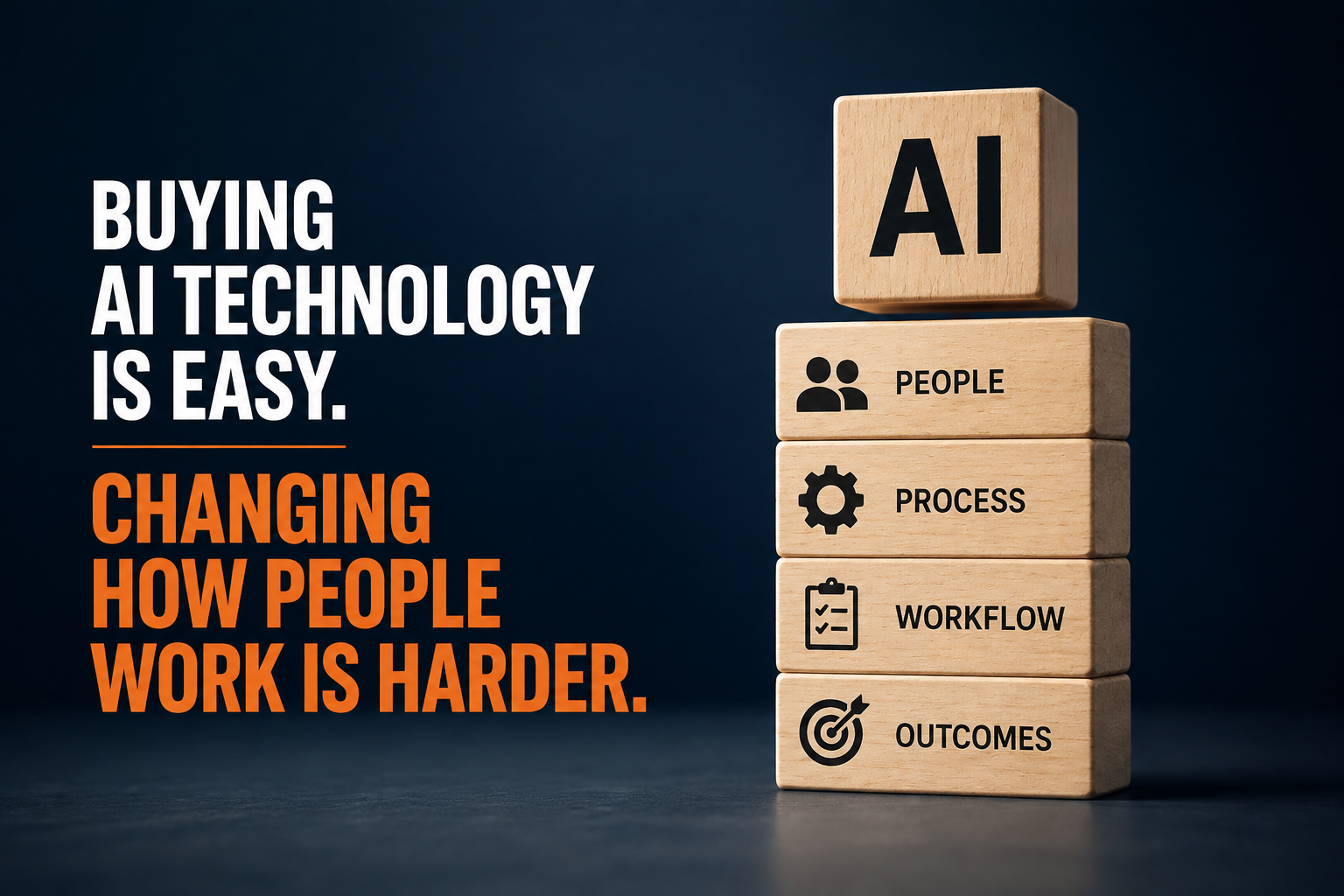
Buying AI technology is easy. Changing how people work is harder.
And that’s the challenge organizations now have to solve.
We Spent the First Era of Generative AI Learning the Tools
The first phase of enterprise generative AI was largely about access and experimentation.
Companies purchased licenses. Employees attended prompt training. Teams experimented with use cases. Organizations created AI policies. `Early adopters figured out how to save time on individual tasks.
That phase mattered. People needed an opportunity to understand what these systems could do.
But we’re entering a different phase now.
The question is shifting from: How can I use AI?
to: How should we do this work now that AI exists?
Those sound similar. They’re fundamentally different questions.
The first is about the tool. The second is about the work.
Adding AI to a Task Isn’t the Same as Redesigning a Workflow
Imagine a communications team developing a proactive media pitch.
- The traditional process might involve:
- Researching the news environment.
- Identifying an emerging angle.
- Researching journalists.
- Reviewing previous coverage.
- Finding supporting data.
- Developing the story.
- Drafting the pitch.
- Reviewing it internally.
- Personalizing outreach.
- Following up.
- Measuring results.
AI can help with almost every one of those activities.
But telling employees to “use AI for media relations” doesn’t answer the questions that actually determine whether the work improves.
Which parts should AI handle?
Which require human judgment?
What information should AI use?
Where does that information live?
What should happen first?
What output from one step becomes the input for the next?
Where should a human review the work?
What standards determine whether an AI-generated output is good enough to move forward?
What should never be delegated?
What can eventually be automated?
And who owns the process?
Those are workflow questions.
And until they’re answered, AI adoption often remains a collection of individual productivity hacks.
The Problem With the Blank Chat Box
There’s another reason this matters.
Give 50 employees access to an AI platform and you may get 50 different ways of doing the same task.
One person writes a detailed prompt.
Another types three words.
Someone uploads the right background information.
Someone else assumes the AI already knows it.
One employee verifies the output.
Another copies and pastes it immediately.
Your strongest AI users gradually develop sophisticated personal systems.
Everyone else improvises.
That’s not an AI operating model.
That’s 50 individual experiments.
And it creates a problem organizations are beginning to recognize:
The value lives with the individual instead of the organization.
If your best AI user figures out a brilliant way to perform a recurring task, that knowledge shouldn’t remain buried in their personal chat history.
It should become organizational knowledge. The process should be captured. The prompts should be reusable where appropriate. The right context should be accessible. The quality standards should be defined. The human checkpoints should be clear. And other employees performing the same work should be able to benefit from what has already been learned.
That’s how organizations move from AI experimentation to AI capability.
Stop Reinventing the Prompt
This is also why I believe shared prompt libraries and repeatable AI processes matter much more than they’re sometimes given credit for.
Prompting is often treated as an individual skill.
But in an organization, a good prompt can become something more valuable: shared infrastructure.
If 30 employees regularly perform the same type of analysis, why should all 30 independently figure out how to instruct AI to do it?
Every time someone starts from scratch, the organization spends more time, introduces more variability and consumes more AI resources than necessary.
A well-designed reusable prompt can capture institutional knowledge:
- The role AI should play.
- The objective.
- The required inputs.
- The relevant context.
- The steps it should follow.
- The standards the output must meet.
- The format in which the result should be delivered.
But even a great prompt is only one piece of the puzzle.
Because most valuable work isn’t one prompt.
It’s a sequence.
From Prompt to Process to Workflow
This is the progression organizations should be thinking about:
Prompt → Process → Workflow → System
A prompt helps AI perform a task.
A process makes that task repeatable.
A workflow connects multiple tasks, people, information sources and decisions.
And eventually, a system can coordinate portions of that workflow across AI, automation, agents and humans.
Consider competitive intelligence.
The goal isn’t simply to create a really good competitor-research prompt.
A mature workflow might continuously identify relevant competitor developments, evaluate their significance, compare them with your organization’s strategy, flag meaningful changes, generate implications for different stakeholders and route important findings to the appropriate people.
Some steps can be performed by AI. Some may eventually be performed by agents. Some require human expertise. Some require approval. Some shouldn’t involve AI at all.
The value comes from designing how those pieces work together.
Don’t Automate a Bad Process
This becomes even more important as organizations move toward agentic AI.
Agents are increasingly capable of doing things rather than simply generating things.
They can research. Retrieve information. Analyze. Create files. Interact with systems. Execute sequences of tasks. And coordinate work across multiple steps.
That sounds exciting, and it is.
But giving AI more autonomy before understanding the workflow introduces an obvious risk:
You can automate the wrong way of working.
If a process contains unnecessary steps, unclear ownership, duplicated effort, outdated approvals or poor information flows, adding an agent doesn’t necessarily solve those problems.
It may simply execute them faster.
Before asking: What agent should we build?
Organizations should ask: How should this work actually happen?
Then determine what humans, AI and automation should each contribute.
This Is Why AI Adoption Is a Change-Management Challenge
AI transformation is often treated as a technology initiative.
But technology is only one part of it.
The harder part is behavioral.
An employee who has performed a task the same way for 15 years has built habits around that process.
They know where the files are.
They know who to ask.
They know what “good” looks like.
They know the shortcuts.
They know when something doesn’t feel right.
Now we’re asking them to reconsider pieces of that process. That requires more than showing them where the AI button is.
People need to understand why the workflow is changing. They need confidence using the technology. They need to understand where their judgment matters. They need clear boundaries. They need examples that relate to their actual work. And they need an opportunity to practice the new process until it becomes normal.
That’s why training remains so important. But the best AI training increasingly shouldn’t happen in isolation from workflow design.
Teach people the technology, yes. Then help them apply it to the work they actually do.
Map the Work Before You Transform It
At Human Driven AI, this is why we’ve become increasingly focused on Human + AI Workflow Blueprints.
Before deciding what to automate or which agent to build, we map the work.
- What is the objective?
- What are the steps?
- Who owns them?
- What information is required?
- Where does that information come from?
- Where are the bottlenecks?
- Where is work duplicated?
- Where does human expertise create the most value?
- Where could AI accelerate the process?
- Where should AI assist rather than act?
- Where are human review and approval required?
- What can become repeatable?
- And what might eventually become agentic?
The goal isn’t to remove humans from the workflow.
It’s to stop making humans do work that machines can do well, while protecting and elevating the work that requires human judgment, creativity, relationships, context and accountability.
That’s a very different goal from “use more AI.”
Your Best AI Users May Already Be Showing You the Future
There’s another opportunity sitting inside many organizations right now.
Some employees have already redesigned pieces of their own work. They’ve created prompt sequences. They’ve built personal workflows. They’ve figured out which context produces better results. They’ve learned where AI fails. They know which tasks save them 10 minutes and which save them three hours.
Organizations should be finding those people.
Not simply celebrating them as power users.
Study what they’re doing. Then determine whether those individual practices should become shared organizational workflows. Because the goal isn’t to have five extraordinary AI users. It’s to make what they’ve learned available to everyone else.
The Next Competitive Advantage Won’t Be Access
Most organizations will eventually have access to excellent AI.
Your competitors will have sophisticated models. They’ll have agents. They’ll have enterprise platforms. They’ll have many of the same technological capabilities you do.
So access alone won’t create lasting differentiation.
How your organization works with AI might.
The advantage will come from how effectively you combine:
- Human expertise.
- Institutional knowledge.
- AI capability.
- Repeatable processes.
- Shared prompts and context.
- Governance.
- Automation.
- And eventually, agents.
Into a way of working that is difficult for another organization to simply purchase. That’s the shift companies need to prepare for.
The first phase of enterprise AI was about putting powerful technology into people’s hands.
The next phase is about redesigning the work around it.
Because buying AI technology is easy. Changing how people work is harder.
And that’s where the real transformation begins.
Remember, AI won’t take your job. Someone who knows how to use AI will. Upskilling your team today, ensures success tomorrow. Custom in-person and virtual trainings are available. If you’re looking for something more top-level to jump start your team’s interest in AI, we offer one-hour Lunch-and-Learns. If you’re planning your next company offsite, our half-day workshops are as fun as they are informational. And, of course, we offer AI consulting and GEO strategies. Whatever your needs, we are your partner in AI success.

Stop Building AI Agents Until You Understand the Work
Everyone wants an AI agent. But automating a workflow you don’t fully understand can simply make a bad process faster. Before organizations deploy agents, they need to determine what should remain human, where AI should assist, what should be automated, and how teams will actually work inside the new system.


65% of Employees Want to Roll Back Workplace AI. The Tech Isn’t the Real Problem.
Employees are adopting AI faster than companies can adapt. Learn why AI change management, workflow redesign, governance and training must come next.

Astra, Fable and the New AI Models Are Changing What Counts as AI Work
GPT-6 Astra and Claude Fable 5.1 are moving AI beyond content generation toward completing complex, multistep workflows.

Your AI Policy Is Just the Beginning. Now, Design How Work Gets Done.
AI governance goes beyond policies. Learn how teams can embed governance into Human + AI workflows through dialogue and intentional decisions.


BREAKING NEWS: NVIDIA to Acquire Hugging Face. What This Means for Marketers
NVIDIA’s acquisition of Hugging Face signals a more open, specialized and complex AI ecosystem. Here is what marketing leaders should understand about model choice, personalization, costs, vendor dependence and governance.

ChatGPT Ads Hit $1 Billion: What It Means for GEO & AI Visibility
ChatGPT Ads have reached a $1 billion annualized run rate. Here’s what the rise of AI advertising means for GEO, brand visibility and the future of digital marketing.

The AI Gender Gap May Start With How We Define AI Talent
Women remain underrepresented in AI. But closing the AI gender gap also means expanding who gets to shape how AI transforms work.

Top 10 Things Your AI Policy Should Include
An effective AI policy should help employees make sound decisions when AI shows up in real work. Here are 10 areas organizations should address—from tools and data to AI agents, transparency, records and human accountability.

The Emerging AI Data Custody Problem: Why an AI Policy Isn’t Enough
Every time an employee uploads a document, analyzes data or asks AI to improve a draft, organizational information moves into an AI system. The question isn’t simply whether employees can use AI. It’s who has custody of that information, what happens to it next, and whether your governance practices follow the work.

Why Most GEO Strategies Fail: Your Content Isn’t Built for the Conversation
Your company may not need more content. It may need better-connected content. Learn why conversation gaps cause brands to disappear as customers move through the GEO Conversation Chain™.

AI Governance Cannot Stand Still When AI Doesn’t
AI is changing faster than most organizational policies. As new models, AI agents, disclosure requirements and regulations emerge, organizations need to move beyond static AI policies toward a living governance practice that evolves with the technology and the work.

Stop Optimizing for One Answer: Own The GEO Conversation Chain™
Your customers aren’t asking AI one question. They’re moving through a chain of prompts, comparisons, objections and decisions. The brands that win won’t simply appear in the first answer. They’ll remain useful throughout the GEO Conversation Chain™.

The AI Questions Changed. So Did Our Research.
Our three-year enterprise AI research didn’t end where we expected. Discover why the questions changed—and download the full 2026 AI Adoption Gap Report.