
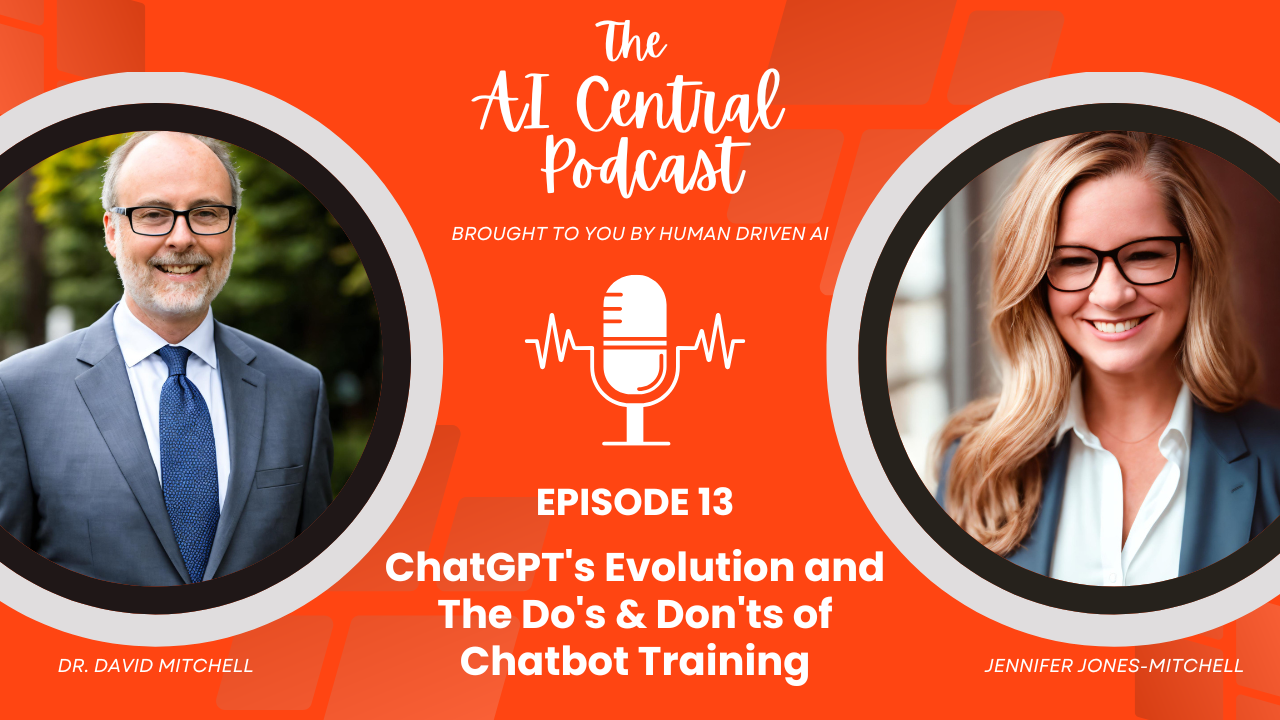
In our latest episode of the AI Central podcast, we discuss the evolution of ChatGPT since it’s launch two years ago. From the early days of ChatGPT’s limited training to the incredible value of custom GPTs. We also discuss the best practices for Chatbot training for marketing, customer service, CX, and conversions. Hope you enjoy the discussion!
You can listen to the podcast here.
Or, watch the video below.
Transcript:
Jennifer Jones-Mitchell: Welcome to the AI Central Podcast brought to you by Human-Driven AI.
Dr. David Mitchell: Thank you so much for joining us.
Jennifer Jones-Mitchell: I’m Jennifer Jones-Mitchell.
Dr. David Mitchell: And I’m Dr. David Mitchell.
Jennifer Jones-Mitchell: Let’s get into it. Well, first of all, I know that we said on our last episode that we were going to talk about chatbots—and we are—but before we do, I wanted to talk a little bit about ChatGPT because just last week, ChatGPT celebrated its second birthday. It is now 2 years old.
Dr. David Mitchell: Wow, that’s incredible, isn’t it?
Jennifer Jones-Mitchell: Seems like it just kicked off the other day, right?
Dr. David Mitchell: It does! I can’t believe it’s been two years, but we were early to the game, that’s for sure.
Jennifer Jones-Mitchell: We were. In fact, I was looking back at my ChatGPT. I wanted to see what were some of the first things that I asked it to do. The very first thing—I don’t know if you remember what you first asked—but most people, upon using ChatGPT for the first time, they would ask it things like, “Write a poem,” or, you know, “Write a song,” or something. And I was no different. I asked it to write a story about our backyard birds.
Dr. David Mitchell: Oh yeah, right.
Jennifer Jones-Mitchell: You remember? Because we were just coming out of the pandemic, and during the pandemic, we spent a lot of time looking at our backyard birds. I started naming them and came up with this whole short story around them, and yeah, that was my very first request—to have ChatGPT expand on that children’s story about our birds.
Dr. David Mitchell: I tried to get it to write lyrics in the style of a Van Morrison song.
Jennifer Jones-Mitchell: I love Van Morrison.
Dr. David Mitchell: Yeah, yeah. It did pretty well, but parts of it were good, and parts of it needed a lot of editing. You know, it’s definitely improved for sure.
Jennifer Jones-Mitchell: Yeah, that’s what’s so interesting because when I looked back at that first set of requests—now granted, I hadn’t understood prompt engineering yet, so the way I was directing it was not very good. Therefore, garbage in, garbage out—the prompts weren’t good, so the output wasn’t good. But it’s still so fascinating to me how it has evolved.
Dr. David Mitchell: It really has.
Jennifer Jones-Mitchell: I have a few numbers here. As of this month—December 2024—there are now 300 million weekly active users.
Dr. David Mitchell: Wow.
Jennifer Jones-Mitchell: 300 million every week.
Dr. David Mitchell: That’s incredible.
Jennifer Jones-Mitchell: And those 300 million people send more than 1 billion messages daily through the platform.
Dr. David Mitchell: H-messages?
Jennifer Jones-Mitchell: Well, requests, prompts, directions…
Dr. David Mitchell: Oh, I was thinking messaging. I was like, can it do that?
Jennifer Jones-Mitchell: Not yet, but I’m sure it can soon.
Dr. David Mitchell: Yeah.
Jennifer Jones-Mitchell: That tracks for me because, I mean, I use ChatGPT for everything now.
Dr. David Mitchell: I do too.
Jennifer Jones-Mitchell: It’s become almost a crutch in so many ways.
Dr. David Mitchell: It’s just incredible. I’ve been using it a lot too, for school and for writing blog posts.
Jennifer Jones-Mitchell: Absolutely.
Dr. David Mitchell: Actually, I wrote an entire course using ChatGPT to teach music appreciation at the Atlanta Institute of Music and Media.
Jennifer Jones-Mitchell: You wrote a whole course?
Dr. David Mitchell: Yep. We’re moving all the classes online, and we wanted to make them asynchronous.
Jennifer Jones-Mitchell: Asynchronous—meaning students don’t have to attend at a specific time. They can do the course at their own pace?
Dr. David Mitchell: Exactly. So I had to shoot videos and write text for students to read. ChatGPT helped me create chapters for each period of music—Renaissance, Baroque, Classical, Romantic, and so on. I focused on three main areas: history, technological innovations, and societal influences on music.
Jennifer Jones-Mitchell: So you’d ask ChatGPT to provide information on each of those areas for a given period?
Dr. David Mitchell: Yes. For example, I’d say, “Give me the history of the Baroque period and its societal influences.” It would list a bunch of ideas, and then I’d find something interesting and ask it to expand on that.
Jennifer Jones-Mitchell: That’s brilliant.
Dr. David Mitchell: In just a few weeks, I had an entire textbook for the class. I also shot videos, using ChatGPT to generate scripts. I even asked it for musical examples. Like, if I said, “What’s a good example of a technological innovation in violin?” it would suggest something like Corelli’s Violin Sonata No. 2.
Jennifer Jones-Mitchell: That’s amazing.
Dr. David Mitchell: So yeah, I was able to put together an entire asynchronous video course very quickly, and it’s all proprietary. The students don’t even have to buy a textbook for the class.
Jennifer Jones-Mitchell: That’s a big deal.
Dr. David Mitchell: It is. Students don’t want to buy textbooks anymore.
Jennifer Jones-Mitchell: Sure, I didn’t want to buy them back then either!
Dr. David Mitchell: Right? You used to have to pay $50, $100, or more for a textbook. Now students refuse to even pay for one, so it’s all out the window. But thanks to ChatGPT, it’s possible to create asynchronous, proprietary content like that.
Jennifer Jones-Mitchell: Incredible.
Dr. David Mitchell: You do have to double-check everything, though. I know the history of music pretty well, so I caught errors where it said one composer did something, but it was actually another. The dates are sometimes questionable too.
Jennifer Jones-Mitchell: That’s always a good reminder: AI should create your first draft, not your final draft. Always check your work.
Dr. David Mitchell: Exactly.
Jennifer Jones-Mitchell: I’ve been thinking about the evolution of ChatGPT. Remember the first iteration?
Dr. David Mitchell: Oh yeah.
Jennifer Jones-Mitchell: It couldn’t generate images back then—and now it can.
Dr. David Mitchell: That’s true.
Jennifer Jones-Mitchell: It couldn’t generate audio either—and now it does.
Dr. David Mitchell: Right.
Jennifer Jones-Mitchell: It’s evolved so much in terms of outputs and functionality. And then, of course, there’s the GPT Store and custom GPTs.
Dr. David Mitchell: I remember when those launched.
Jennifer Jones-Mitchell: I was so excited! I thought, “Oh, it’s like an app store for GPTs. I’ll create GPTs and sell them there.” I’m training a couple I hope to sell through a subscription service, but honestly, I’ve found I just want to hold onto them. The custom GPTs I’m creating are transforming how I work.
Dr. David Mitchell: For example?
Jennifer Jones-Mitchell: Well, for any listeners who don’t know, with ChatGPT-4 Omni, you can design and train custom GPTs to perform all kinds of tasks. You can train them on your data. For instance, I recently gave a presentation to real estate experts in Canada and demonstrated how I created a dummy GPT for them.
Dr. David Mitchell: What kind of GPT?
Jennifer Jones-Mitchell: It was trained on fake property listings I created.
Dr. David Mitchell: Fake listings?
Jennifer Jones-Mitchell: Yes, just for the demo. What’s exciting is that because of ChatGPT’s evolution, it now includes search capabilities. I didn’t include prices in my fake listings since I’m not a realtor, so I trained my GPT to compare the listings to local comps and generate pricing.
Dr. David Mitchell: It can do that?
Jennifer Jones-Mitchell: Oh, it can. The realtors were blown away. The GPT pulled up real comparable listings, suggested pricing, and even wrote descriptions for the properties.
Dr. David Mitchell: That’s impressive.
Jennifer Jones-Mitchell: It gets better. I also asked it to analyze what was missing from my property descriptions compared to other realtors’ listings.
Dr. David Mitchell: And it worked?
Jennifer Jones-Mitchell: It did. The GPT even pulled up real listings from the realtors in the audience!
Dr. David Mitchell: No way.
Jennifer Jones-Mitchell: Yes, way! They were seeing their own listings appear during the demo, and it showed what their descriptions emphasized versus what mine were missing.
Dr. David Mitchell: That must’ve gotten a lot of attention.
Jennifer Jones-Mitchell: It did.
Dr. David Mitchell: And, you got some new leads from that, right?
Jennifer Jones-Mitchell: I got tons of new business leads from that presentation.
Dr. David Mitchell: That’s fantastic.
Jennifer Jones-Mitchell: And it leads me to something else exciting about ChatGPT now: Search GPT.
Dr. David Mitchell: Oh yeah.
Jennifer Jones-Mitchell: Remember when ChatGPT first launched, it couldn’t search the web?
Dr. David Mitchell: That’s right.
Jennifer Jones-Mitchell: Even its knowledge base was limited—it was only trained up until spring 2021.
Dr. David Mitchell: That’s true.
Jennifer Jones-Mitchell: But now it can search the web, and it automatically includes sources for you.
Dr. David Mitchell: Incredible.
Jennifer Jones-Mitchell: It’s a game changer. Months ago, I started training AI models on my brand to optimize for AI search, or what I call AISO—AI Search Optimization. It’s about creating conversational content—like transcripts, Q&As, and FAQs—because that’s what AI prioritizes. I started feeding this content into search and AI models, and it works.
Dr. David Mitchell: How do you know?
Jennifer Jones-Mitchell: I had a business call recently, and when I asked how they found me, they said, “I asked ChatGPT for an AI trainer in Atlanta, and it recommended you.”
Dr. David Mitchell: Wow.
Jennifer Jones-Mitchell: This is the first time since Google launched that there’s been a real competitor to search.
Dr. David Mitchell: It’s amazing.
Dr. David Mitchell: It really is amazing. I still use Google, but honestly, I don’t look below the AI overview very often anymore.
Jennifer Jones-Mitchell: Exactly. It’s going to disrupt Google’s business model in a big way.
Dr. David Mitchell: You think so?
Jennifer Jones-Mitchell: I know so. Google’s ad revenue is going to take a huge hit. Think about it: $40 billion annually is spent on paid search through Google, and all that prime real estate—those top spots that used to be for paid search—is now taken up by AI overviews.
Dr. David Mitchell: That’s true.
Jennifer Jones-Mitchell: Experts are predicting Google will lose somewhere between 50 to 80% of its search activity to AI by next year.
Dr. David Mitchell: That’s incredible.
Jennifer Jones-Mitchell: It is. And here’s the thing: I barely use Google myself now. When I need an answer or want to find something, I just open ChatGPT.
Dr. David Mitchell: Same here. For example, with Pro Tools, we show students how to ask ChatGPT how to do something step by step. It’s faster, more concise, and skips all the ads and irrelevant content you’d have to sift through on Google.
Jennifer Jones-Mitchell: And really, just going back to the custom GPTs for a minute. In fact, here, let me just pull it up and give everybody an idea of some of the ones I use. Like, right here, I have Tax Advisor, which helps me. That’s a custom GPT that I’ve trained on my company’s taxes.
Dr. David Mitchell: Oh, interesting.
Jennifer Jones-Mitchell: Yeah, it helps me keep track of everything, answer questions, and let me know things like, “What’s a write-off?”
Dr. David Mitchell: A write-off.
Jennifer Jones-Mitchell: It’s a write-off.
Dr. David Mitchell: Who writes it off?
Jennifer Jones-Mitchell: The write-off people.
Dr. David Mitchell: [Laughs] Sorry, we’re quoting Schitt’s Creek if you don’t know.
Jennifer Jones-Mitchell: Exactly. Then, I’ve got an ad content creator, my Human-Driven AI business development GPT, and a media pitching GPT.
Dr. David Mitchell: Media pitching GPT?
Jennifer Jones-Mitchell: Yes. I’ve trained it on specific reporters I pitch often. I’ve literally trained the custom GPT on their personas, given it the articles and stories they’ve written, so it understands the topics, beats, and styles they cover. Then I brainstorm story ideas to pitch with it.
Dr. David Mitchell: That’s genius.
Jennifer Jones-Mitchell: Thanks. I’ve also got a translator I created for a client, different client personas, my lead management GPT, and my decision-maker GPT.
Dr. David Mitchell: Decision-maker GPT?
Jennifer Jones-Mitchell: Yes, I love this one because it really helps me. You know I have a million ideas all the time—not all of them are the best. So, I’ve trained a decision-maker GPT to help me analyze which ideas will deliver the best return in the shortest amount of time.
Dr. David Mitchell: That’s so smart.
Jennifer Jones-Mitchell: It really is. It helps me focus my time and efforts where there’s the greatest ROI. It also helps with other business decisions.
Dr. David Mitchell: That’s incredible.
Jennifer Jones-Mitchell: It is. And those are just a few examples. I’ve also got a crisis comms GPT and so many others that help me with my daily work. And that doesn’t even include all the ones I’m creating for clients.
Dr. David Mitchell: Amazing.
Jennifer Jones-Mitchell: But I do want to remind everyone: if you are creating a custom GPT, these still live behind OpenAI’s firewall. You always want to anonymize anything you share with it and be careful about sharing company IP.
Dr. David Mitchell: That’s good to know.
Jennifer Jones-Mitchell: Yeah. These are not custom LLMs, which live behind your own firewall and can be fully private. Still, even though they don’t have that extra layer of protection, the amount of tasks you can automate with a well-trained GPT is incredible.
Dr. David Mitchell: It’s kind of like having experts in different fields you can brainstorm with at your disposal.
Jennifer Jones-Mitchell: Exactly.
Dr. David Mitchell: It’s pretty amazing, isn’t it?
Jennifer Jones-Mitchell: It really is.
Dr. David Mitchell: I tried to create one—a music theory GPT. It will answer some questions accurately, but it can’t yet draw a musical staff properly.
Jennifer Jones-Mitchell: Oh no!
Dr. David Mitchell: Yeah. I was hoping to create flashcards for my students, where it would quiz them on notes on the staff, but it can’t draw one correctly.
Jennifer Jones-Mitchell: That’s frustrating.
Dr. David Mitchell: No matter how I’ve tried to train it—loading a picture in there, explaining what a staff looks like—it still comes back with squiggly lines, uneven spacing, or too many lines.
Jennifer Jones-Mitchell: That’s wild.
Dr. David Mitchell: It’s weird. But it’ll probably get there.
Jennifer Jones-Mitchell: When’s the last time you tried?
Dr. David Mitchell: Not too long ago. I was surprised because now it can create images, but it still can’t get the staff quite right.
Jennifer Jones-Mitchell: Yeah, and it still struggles with text on images, too.
Dr. David Mitchell: Exactly.
Jennifer Jones-Mitchell: But like you said, it’ll get there. The evolution since its launch two years ago has been remarkable.
Dr. David Mitchell: It really has.
Jennifer Jones-Mitchell: I mean, it’s just fascinating.
Dr. David Mitchell: I’ve been using it to brainstorm lyrics for songs.
Jennifer Jones-Mitchell: Oh, really?
Dr. David Mitchell: Yeah. I’m not as strong at lyric writing as I am at music composition, so it’s been great to get help with that.
Jennifer Jones-Mitchell: That’s awesome.
Dr. David Mitchell: You can give it a line of music and ask it to write the next line, or even give it part of the lyrics and ask it to finish the rest.
Jennifer Jones-Mitchell: That’s fascinating.
Dr. David Mitchell: It’s an amazing tool.
Jennifer Jones-Mitchell: And with the addition of search within ChatGPT, it’s a game changer.
Dr. David Mitchell: Totally.
Jennifer Jones-Mitchell: I used to tell clients, “If you’re going to use ChatGPT, that’s great, but you also need another search AI, like Perplexity.” But now, ChatGPT can search the web itself.
Dr. David Mitchell: That’s huge.
Jennifer Jones-Mitchell: It is. The more it encompasses different tasks, the fewer additional models you’ll need in your tech stack.
Dr. David Mitchell: That’s incredible.
Jennifer Jones-Mitchell: It really is. For example, I recently asked ChatGPT to go to the AIM website, read the blogs there, and suggest five SEO-friendly topics for new blog posts.
Dr. David Mitchell: And did it work?
Jennifer Jones-Mitchell: It did. I chose one of the suggestions, asked it to write the blog post, and then expanded on a few sections and edited it myself.
Dr. David Mitchell: That’s impressive.
Jennifer Jones-Mitchell: It really is. And I’ve also trained it on my own writing style.
Dr. David Mitchell: Same here! I uploaded music theory papers from my doctorate program and had it analyze my style. Now, it can write “in the voice of Dr. David Mitchell.”
Jennifer Jones-Mitchell: That’s fantastic.
Dr. David Mitchell: It is. I’ve also used it to find and respond to new RFPs.
Jennifer Jones-Mitchell: Me too. ChatGPT’s ability to search and its new API integrations with tools like Salesforce and HubSpot make it incredibly powerful for automating lead generation.
Dr. David Mitchell: That’s amazing.
Jennifer Jones-Mitchell: It really is. Honestly, I’m starting to dream in AI now!
Dr. David Mitchell: I believe it.
Jennifer Jones-Mitchell: I can’t wait to see where it’s headed. In our next episode, I’m going to dive into predictions for AI in 2025, especially with the incoming administration’s plans for deregulation.
Dr. David Mitchell: That’s going to be an important discussion.
Jennifer Jones-Mitchell: It will be. Because that’s that you know could potentially be something that that Brands need to especially start um preparing for. But I’m going to shift away from ChatGPT if you’re good.
Dr. David Mitchell: Yeah, all right.
Jennifer Jones-Mitchell: Well, as I said at the end of our last episode, I wanted to talk a little bit about chatbots. So let me ask you first, what is your general impression of chatbots? What do you think of them? How often do you use them?
Dr. David Mitchell: You know, I’ve used them a few times. When I’m trying to get things done with a bank or investments or whatever, they can be helpful.
Jennifer Jones-Mitchell: Okay.
Dr. David Mitchell: But a lot of times, when I really need help, I end up needing a person on the phone. And that’s hard to do because they’re all trying to push you to the chatbot.
Jennifer Jones-Mitchell: Yeah, yeah.
Dr. David Mitchell: So, I don’t use them super often. But when I have, they’ve been effective. Like, if you’re trying to find your routing number for something, the chatbot will tell you, “Go here,” and there it is.
Jennifer Jones-Mitchell: That’s true.
Dr. David Mitchell: So, yeah, they can be pretty helpful.
Jennifer Jones-Mitchell: Yeah, I used to hate chatbots.
Dr. David Mitchell: Really?
Jennifer Jones-Mitchell: Oh, yeah. But I do love them now—only, however, when they are trained well.
Dr. David Mitchell: That makes sense.
Jennifer Jones-Mitchell: Quick stat that blows my mind: 99% of Millennials—which, I mean, let’s just call it 100%—
Dr. David Mitchell: [Laughs] Right.
Jennifer Jones-Mitchell: 100% of Millennials would prefer to talk to a chatbot than a human being.
Dr. David Mitchell: Wow, that’s incredible.
Jennifer Jones-Mitchell: Isn’t it?
Dr. David Mitchell: I can see why, though.
Jennifer Jones-Mitchell: Yeah. I know our daughter doesn’t like to call anyone or talk on the phone.
Dr. David Mitchell: No, she doesn’t.
Jennifer Jones-Mitchell: It’s like pulling teeth.
Dr. David Mitchell: It really is.
Jennifer Jones-Mitchell: And I think we’re moving more and more toward that.
Dr. David Mitchell: Yep.
Jennifer Jones-Mitchell: But what I find really interesting—or I guess annoying—is if I see one more poorly trained chatbot, I may just lose it.
Dr. David Mitchell: [Laughs] Yeah.
Jennifer Jones-Mitchell: Honestly. So, I just wanted to go over a few things that marketers and brand leaders need to think about when putting together their chatbots.
Dr. David Mitchell: Okay.
Jennifer Jones-Mitchell: The first one is: make sure you train it on your brand’s voice. I hate it when there’s such a disconnect between the brand’s personality, persona, and voice, and then you get a chatbot that sounds nothing like the brand.
Dr. David Mitchell: Yeah.
Jennifer Jones-Mitchell: It sounds like a robot, not at all like the personality you expect from the brand.
Dr. David Mitchell: How would you train it on the voice?
Jennifer Jones-Mitchell: Oh, it’s simple. When you’re teaching it how to engage, you also teach it how to talk. You say, “Our brand is friendly,” or, “Our brand is youthful,” or, “Our brand is professional.” Whatever your brand’s marketing voice is, train your chatbot on that. You want the customer’s experience with the chatbot to match the experience they’d have with anyone in your company, your website, or your app.
Dr. David Mitchell: Makes sense.
Jennifer Jones-Mitchell: Consistency is key. And then, of course, you need to ensure the chatbot has a deep understanding of your products and services. It should guide customers effectively.
Dr. David Mitchell: Yeah, I’ve used chatbots to find information about products, and it’s frustrating when they can’t answer your questions.
Jennifer Jones-Mitchell: Exactly. That’s happened to me so many times. And that’s when I end up thinking, “Forget this,” and trying to call someone.
Dr. David Mitchell: Yep, same here.
Jennifer Jones-Mitchell: The other thing that drives me nuts is when chatbots ask open-ended questions like, “How can I help you today?”
Dr. David Mitchell: Yeah, that’s bad.
Jennifer Jones-Mitchell: It’s just bad marketing. You can literally train your chatbot to offer specific options. For example, I recently gave a speech to a group of realtors, and we talked about this. Instead of saying, “How can I help you today?” the chatbot could ask, “Would you like to buy a home, sell a home, or schedule an appointment?”
Dr. David Mitchell: That’s great.
Jennifer Jones-Mitchell: Right? And if I click “buy a home,” the chatbot can qualify that lead: “What type of home are you looking for? What area?” It guides the customer through the process.
Dr. David Mitchell: That’s smart.
Jennifer Jones-Mitchell: There’s a company called Save Max Canada that did this really well. They generated thousands of leads through their chatbot in just a few months, and those leads actually converted.
Dr. David Mitchell: Wow, that’s incredible.
Jennifer Jones-Mitchell: It is. And it’s because they didn’t have open-ended questions. They had clear calls to action, guiding customers step by step.
Dr. David Mitchell: You always say, “Have a call to action.”
Jennifer Jones-Mitchell: Exactly. Each step should offer specific options. That’s how you push an initial inquiry all the way to conversion.
Dr. David Mitchell: Makes sense. And you can help companies do this, right?
Jennifer Jones-Mitchell: Yes, I can. And I want to because poorly designed chatbots drive me crazy.
Dr. David Mitchell: I can see that.
Jennifer Jones-Mitchell: Another thing is troubleshooting. Think through the most common problems people might ask about and train the chatbot to handle those. You want to create a decision tree that follows the natural progression of a customer’s inquiry.
Dr. David Mitchell: That’s a great idea.
Jennifer Jones-Mitchell: It really is. If a customer is asking about a product and you have multiple versions of that product, the chatbot should give them choices. Train it with the right data sets to handle all of this.
Dr. David Mitchell: That’s smart.
Jennifer Jones-Mitchell: But it’s not just about conversions or customer service. You also need to bake in guardrails.
Dr. David Mitchell: Guardrails?
Jennifer Jones-Mitchell: Yes. If someone can abuse or misuse a chatbot, they will. It could be something silly like trying to make the chatbot talk like a pirate.
Dr. David Mitchell: [Laughs] That’s true.
Jennifer Jones-Mitchell: Or it could be something serious, like asking questions to try and extract proprietary information.
Dr. David Mitchell: That’s a risk.
Jennifer Jones-Mitchell: Exactly. So, you need to train your chatbot on what it can and cannot do and include that in the decision tree.
Dr. David Mitchell: Makes sense.
Jennifer Jones-Mitchell: Trust me, if there’s a way to have fun with your bot—or worse, misuse it—someone will find it.
Dr. David Mitchell: Human nature, I guess.
Jennifer Jones-Mitchell: Exactly. So, train it not to share harmful or private information and teach it to redirect conversations that go off track.
Dr. David Mitchell: That’s really smart.
Jennifer Jones-Mitchell: It’s so important. I think we’re going to see a real evolution of chatbots as the machines get smarter and the people training them get smarter.
Dr. David Mitchell: Definitely.
Jennifer Jones-Mitchell: And that’s going to create new jobs—training AI and structuring data sets.
Dr. David Mitchell: It already is creating jobs.
Jennifer Jones-Mitchell: True. There will be job losses, but there will also be new opportunities, especially around custom LLMs, GPTs, and using models in general.
Dr. David Mitchell: It’s a whole new world.
Jennifer Jones-Mitchell: It really is.
Dr. David Mitchell: I was just hearing about that on NPR. They were saying how writing jobs are changing. People who know how to use ChatGPT to enhance their writing will be more employable.
Jennifer Jones-Mitchell: Absolutely. Like I always say, “AI won’t take your job. Someone who knows how to use AI will.”
Dr. David Mitchell: That’s the truth.
Jennifer Jones-Mitchell: It really is.
Dr. David Mitchell: Hopefully, everyone keeps learning and adapting.
Jennifer Jones-Mitchell: Agreed. I think we’ve chatted this topic to death, though.
Dr. David Mitchell: [Laughs] Yeah.
Jennifer Jones-Mitchell: So, we’ll wrap up here. Please join us for our next episode, where I’ll discuss predictions for AI in 2025 and the implications of the incoming administration’s plans for deregulation.
Dr. David Mitchell: That’s going to be a big topic.
Jennifer Jones-Mitchell: It is. Thank you so much for joining us today.
Dr. David Mitchell: Thanks, everyone!
Jennifer Jones-Mitchell: See you next time.
[Music plays, outro ends.]
Remember, AI won’t take your job. Someone who knows how to use AI will. Upskilling your team today, ensures success tomorrow. In-person and virtual training workshops are available. Or, schedule a session for a comprehensive AI Transformation strategic roadmap to ensure your marketing team utilizes the right GAI tech stack for your needs.

Claude Cowork Is Changing AI From a Tool to A Teammate
Claude Cowork points to a bigger shift in workplace AI: from asking AI to complete individual tasks to delegating pieces of a workflow. The opportunity isn’t simply faster work. It’s deciding what AI should own, what humans should own and how the two work together.


ChatGPT WORK Begs the Question: What Work Can I Give to AI?
ChatGPT Work represents an important shift in enterprise AI: from asking AI to complete individual tasks to giving it a defined role inside a workflow. For marketing and communications teams, that changes the conversation from better prompting to better work design.

AI Governance Is Becoming a Reputation Issue. Where Are Communications Leaders?
AI governance shapes more than compliance. Katherine Morales, APR explains why communications leaders must help protect trust, credibility and reputation.
