
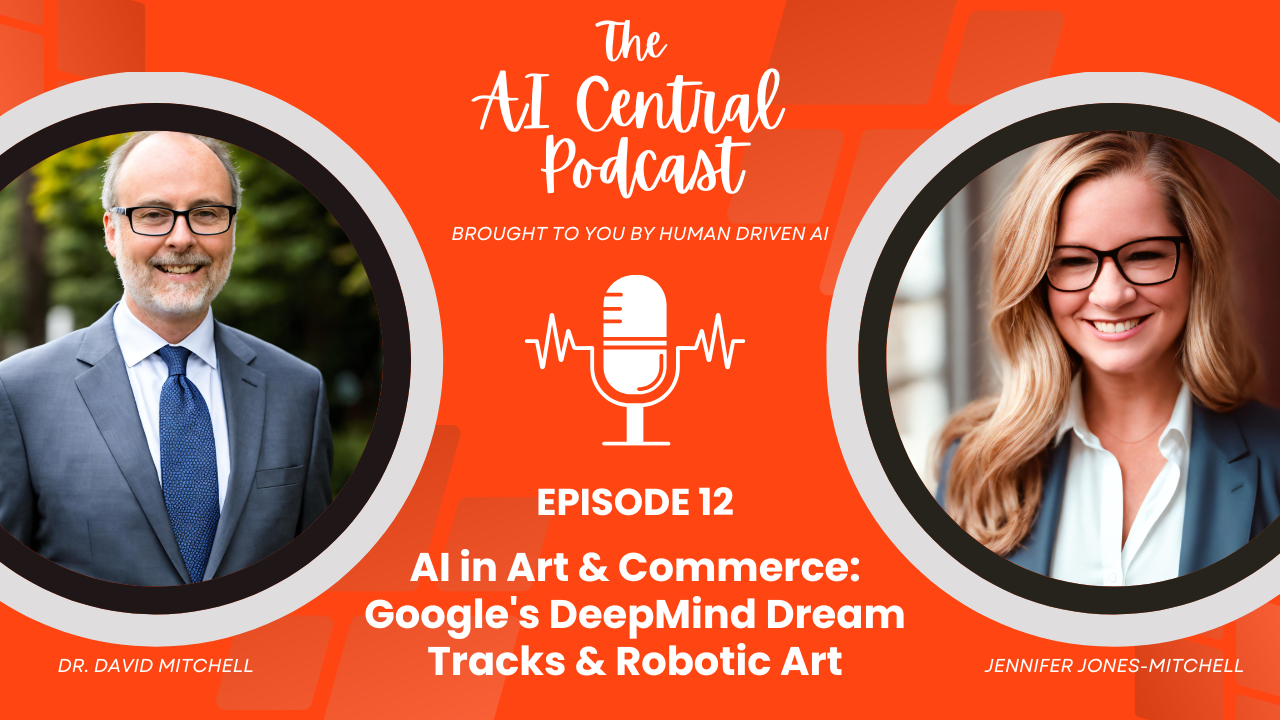
In a recent podcast episode, music composer, educator and Chief Education Officer for Human Driven AI, explains how Google’s DeepMind Dream Track.
This technology is enabling artists to do more than ever before. From composition to complete studio production, AI is democratizing how music is created.
Plus, we discuss how robots are now helping sculptural artists bring their visions to life faster and at greater scale than ever before.
You can listen to the podcast here.
Or, watch the video.
Check it out and let me know – do you think music is still art if AI is used to help create it?

Transcript
Here’s the transcript with the speakers reversed and completed in full:
Transcript
Jennifer Jones-Mitchell: Welcome to the AI Central Podcast, brought to you by Human-Driven AI.
Dr. David Mitchell: All right, so what I’d like to talk about today is YouTube’s new Dream Track.
Jennifer Jones-Mitchell: Ah, yes, yes, I’ve read a lot about it. Tell us, tell us, what’s going on?
Dr. David Mitchell: Yeah, so it’s brand new, and select YouTubers who have high audiences obviously are training the AI essentially. Universal Music has entered a contract with YouTube and with influencers to create 30-second reels for their videos using music and the AI voice likeness of John Legend, Demi Lovato, Charlie XCX, and a total of nine artists essentially. You can basically create a 30-second musical track with John Legend’s voice by just typing in a text prompt.
Jennifer Jones-Mitchell: Yeah, and you can put in the lyrics to the song that you want, and then he’ll sing it perfectly, you know.
Dr. David Mitchell: Yeah, it’s fascinating. Or you can hum a tune and create a melody from that. That becomes a 30-second AI track that you can drop onto any video you’re uploading to YouTube. Select people are using it, testing it out, and training it at this point. It’ll become available to the general public soon, I’m sure.
Jennifer Jones-Mitchell: So I could create a song sung by John Legend, is what you’re telling me?
Dr. David Mitchell: Exactly, yep. Just like you do text-to-video or text-to-art, you could say, “Write a song about AI and marketing,” and John Legend would sing a song about AI and marketing.
Jennifer Jones-Mitchell: And to that point, what we’ll do is cut to a video right here. Cut to video.
Dr. David Mitchell: Here’s how it works: when creating a YouTube short, in the music picker, I tap on the “Create” button and enter a prompt. Naturally, I had to go with something fun, so I entered a simple prompt, “My puns so juicy,” and selected Troye Sivan as my singer. Then my mind was blown. Take a listen:
“It’s the best I’ve ever tasted. It’s so ripe and sweet and juicy.”
Other artists include Demi Lovato, Charlie Puth, Sia, Tate McRae, and more. Each prompt creates a completely original 30-second song that I can use as a backing track in my shorts. What that’s going to do is become the ultimate passive income for musicians and artists.
Jennifer Jones-Mitchell: Sure, yeah. For established artists, though.
Dr. David Mitchell: Yes, right now, it’s established artists, and there are only nine of them, of course. But eventually, it will be more artists, obviously. It makes it possible for an artist to generate passive income without being directly involved. They’re just sitting back and letting it happen.
Jennifer Jones-Mitchell: That is wild. But I was thinking about how people could do nefarious videos where they have John Legend singing stuff he wouldn’t want to be associated with.
Dr. David Mitchell: Exactly. They must have guardrails. I think it’s probably tied to Universal’s contract and YouTube’s norms. Probably nothing political, obscene, or controversial.
Jennifer Jones-Mitchell: So this is only on YouTube?
Dr. David Mitchell: Yes, it’s called Dream Track AI. I wrote a blog post about it, which we can link to. Historically, passive income was tied to recordings—physical copies, then streaming—but you still had to go to the studio. With this, the income is truly passive because you’re not directly involved.
Jennifer Jones-Mitchell: And that’s fascinating. It changes everything for music creation and distribution. But I’m curious—what about independent artists who aren’t under contract with anyone? How does this work for them?
Dr. David Mitchell: Good question. I did some research on that, but it’s so new that right now it’s just in the experimental stage. It’s unclear how it will play out for independent artists, but it raises fascinating questions about art and whether this is truly music when it’s generated like this.
Jennifer Jones-Mitchell: Generated by AI, you mean? By an algorithm?
Dr. David Mitchell: Essentially, yeah. I think it’s still art. But there’s a difference when you’re creating something using someone else’s voice—that’s a whole other can of worms.
Jennifer Jones-Mitchell: That’s true. And it reminds me of when tools like Google’s DeepMind launched music AI tools, like Music FX DJ and Music AI Soundbox. These are more about straight-up text-to-music creation, right?
Dr. David Mitchell: Right. They’re similar but focused on composition from scratch, often with collaboration features. That, to me, still qualifies as art. Even if it’s experimental or algorithmic, it still has artistic merit.
Jennifer Jones-Mitchell: And you know, you’ve done something similar with Max MSP, haven’t you?
Dr. David Mitchell: Yeah, Max MSP is an amazing tool for music and video interaction. I’ve used it to improvise with algorithms. You input a note, and it generates a whole composition. It’s like a dialogue between you and the algorithm.
Jennifer Jones-Mitchell: I love how that ties into experimental music and algorithmic art. It’s fascinating how these tools open up more creative possibilities.
Dr. David Mitchell: Exactly. It’s all about using the tools to amplify your vision, whether you’re working on music, sculpture, or anything else. You’re still the artist in the driver’s seat.
Jennifer Jones-Mitchell: That’s such a great point. And it ties back to why we named the company Human-Driven AI. AI is just a tool—it still requires human creativity to guide it.
Dr. David Mitchell: Right. And as more tools like this emerge, I think we’ll see a blend of AI-assisted and handmade art. Both will have their place, and perhaps handmade work will even become more valuable.
Jennifer Jones-Mitchell: That’s a great way to look at it. Thank you so much for listening, everyone! In the next episode, we’ll discuss how chatbots can drive not just lead generation but lead conversion. See you then!
Remember, AI won’t take your job. Someone who knows how to use AI will. Upskilling your team today, ensures success tomorrow. In-person and virtual training workshops are available. Or, schedule a session for a comprehensive AI Transformation strategic roadmap to ensure your marketing team utilizes the right GAI tech stack for your needs.

Claude Cowork Is Changing AI From a Tool to A Teammate
Claude Cowork points to a bigger shift in workplace AI: from asking AI to complete individual tasks to delegating pieces of a workflow. The opportunity isn’t simply faster work. It’s deciding what AI should own, what humans should own and how the two work together.


ChatGPT WORK Begs the Question: What Work Can I Give to AI?
ChatGPT Work represents an important shift in enterprise AI: from asking AI to complete individual tasks to giving it a defined role inside a workflow. For marketing and communications teams, that changes the conversation from better prompting to better work design.

AI Governance Is Becoming a Reputation Issue. Where Are Communications Leaders?
AI governance shapes more than compliance. Katherine Morales, APR explains why communications leaders must help protect trust, credibility and reputation.
